Dental Fee Guide Increases for 2026
Background
Every year the dental associations for each province and territory release their respective dental fee guides for reference by dentists, insurers and the general public.
As background:
Dental fee guides specify fees for most available dental services, as identified by the corresponding 5-digit procedure codes.
While most provinces and territories release their updated fee guides in January, some release the update in February or later in the year without a fixed timeframe.
These fee guides serve purely as guidance for dentists and are not mandatory, although many dental practices follow them closely.
The updates to the fees each year typically reflect some level of trend adjustment, which varies by province.
Most insurers will establish their reasonable and customary (R&C) reimbursement rates based on these fee guides such that the guides will directly impact group dental plan costs.
2026 Fee Guide Increases
We reviewed the provincial fee guide increases confirmed by several insurers across the market and used this information to come to the overall fee guide increases by province. The 2026 increases are shared in Figure 1 below alongside historical increases.
Figure 1: Dental Fee Guide Increases by Province (2023 to 2026)
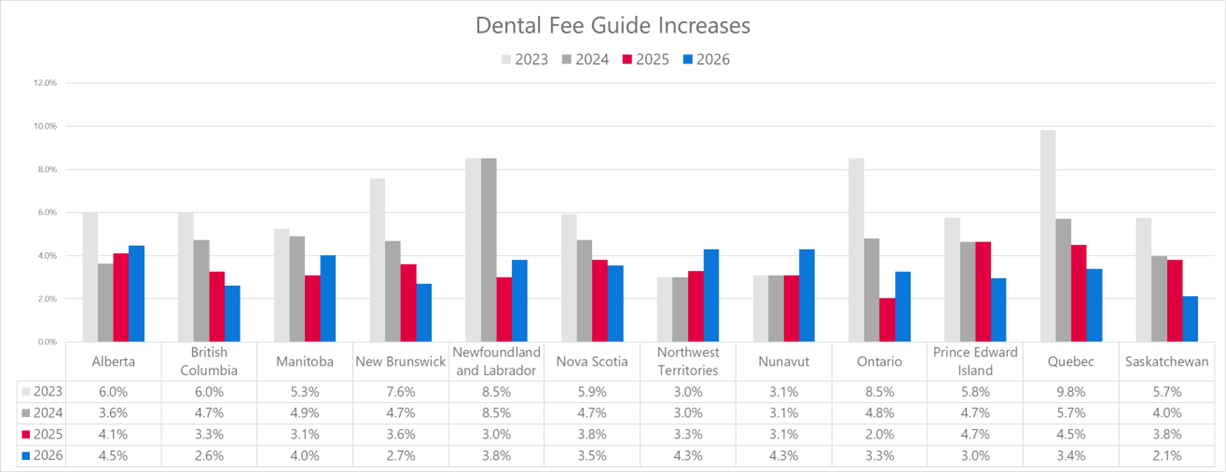
Please note that the increases for Yukon Territories have not been included as this information was not fully available.
The 2026 average provincial fee guide increase (non-weighted) was 3.46% while Canadian annual consumer price index (CPI) increase at year-end 2025 was 2.36%.
Our Thoughts
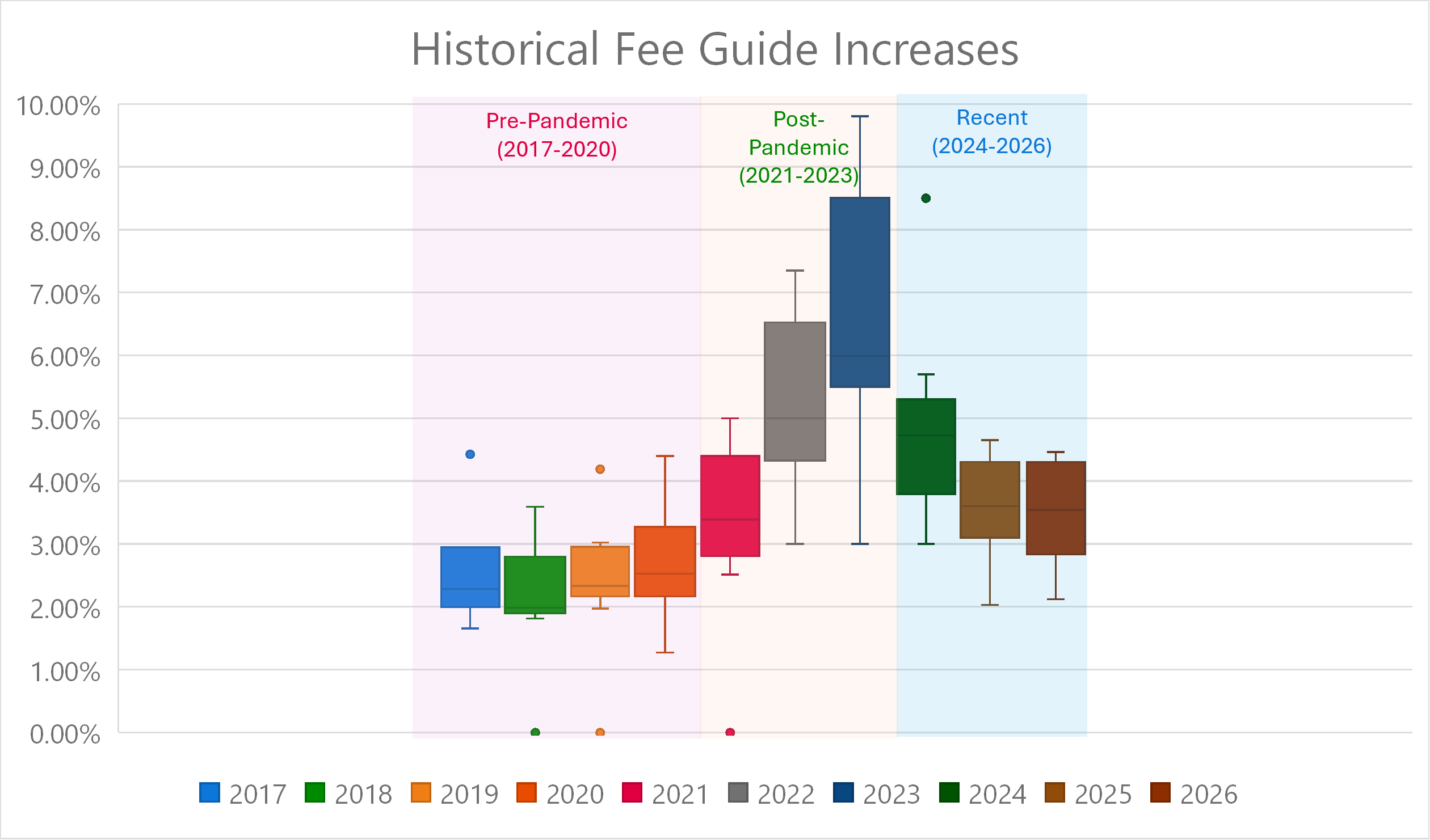
There has been a reshaping of fee guide increases post-pandemic. As shown in the visual below (Figure 2), in the years 2017 to 2020 (“Pre-Pandemic”) fee guide increases were commonly in the range of roughly 2.0% to 3.0% per year.
Immediately following the pandemic (“Post-Pandemic”), over the years 2021 to 2023, fee guide increases were highly variable – over 8.0% in 2023 for some provinces. This was driven by post-pandemic influences such as pent-up demand for services, increased requirements around personal protective equipment (PPE) and high levels of general CPI inflation.
In more recent experience (“Recent”) for 2024 to 2026, we have seen fee guide increases in the range of roughly 3.0% to 4.5% annually – lower than immediately post-pandemic, but still not down to previous norms.This may be a short term phenomenon, but with a compounding effect it could add up if persistent.
Figure 2: Distribution of Historical Provincial Fee Guide Increases by Year (2017 to 2026)
Plans should be wary that this could be a “new norm” for fee guide increases. After also factoring in a buffer for other drivers of dental trend (e.g., utilization increases, population aging, industry innovation), we are looking at a dental trend assumption in the range of potentially 4.0% to 6.0% annually overall.
That said, this will continue to vary by province – for reference, the lowest increase for 2026 was in Saskatchewan (2.12%) and the highest increase for 2026 was in Alberta (4.46%).BC was on the lower end at 2.62%.Trend rates by plan will also further vary by aspects such as plan design.
Overall, plans will want to monitor their experience over the coming years and ensure they are establishing realistic rates for the current environment to avoid erosion of any previously established reserves.
Jojy Oommen
Partner